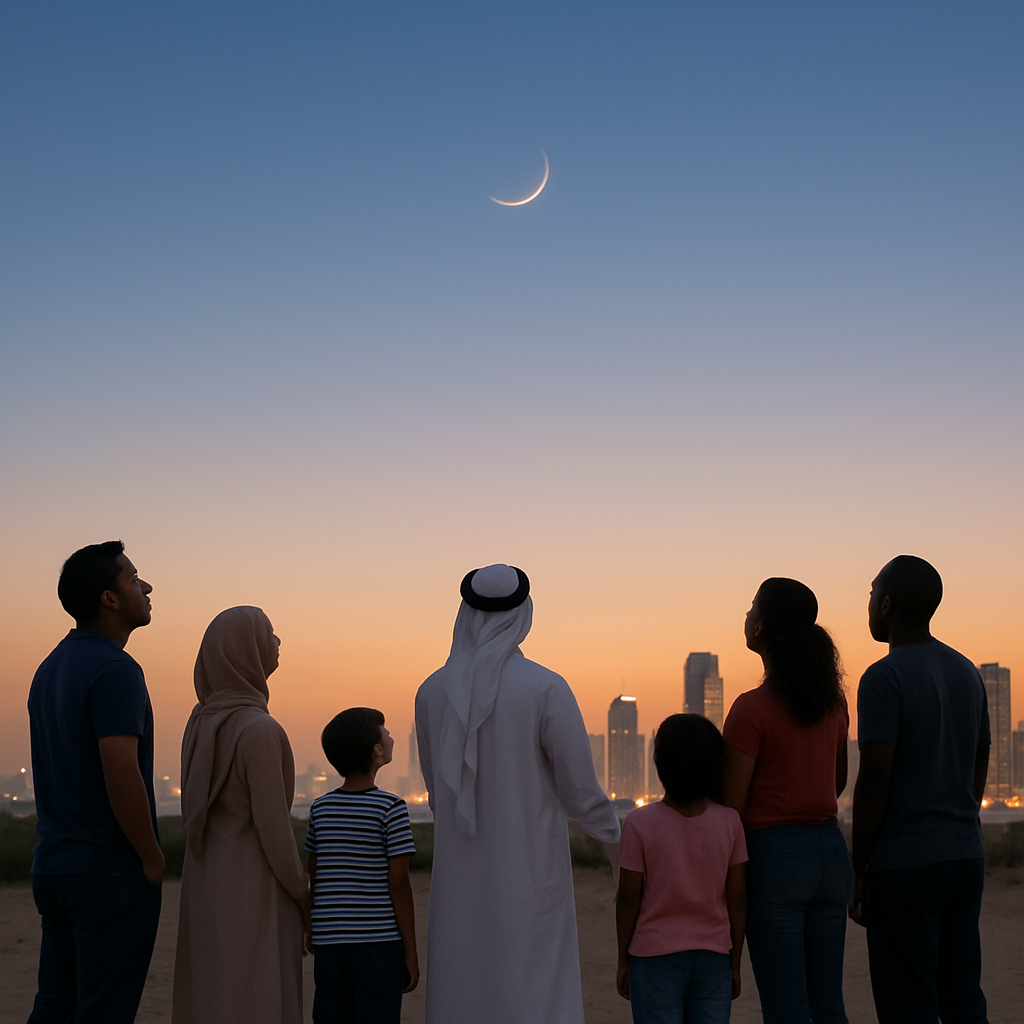
The crescent moon for Jumada al-Awwal 1448 in 2026 won’t be visible after sunset on 11 October with the naked eye or a telescope. The month is expected to start on 12 or 13 October, depending on methods used to confirm its sighting.
Key facts
- The crescent will not be visible on 11 October 2026, after sunset.
- Jumada al-Awwal 1448 may begin on 12 or 13 October 2026.
- Visible through advanced techniques before sunset on 11 October 2026.
- The new moon occurs at 7:50 pm on 10 October 2026.
- 15 minutes above the horizon, at 3 degrees and 6 minutes.
Why can’t we see the crescent moon on 11 October 2026?
The Sharjah Space and Astronomy Hub announced that on 11 October 2026, the crescent moon for Jumada al-Awwal will not be visible to the naked eye after sunset. This is because the moon will be only 21 hours and 9 minutes old, and its brightness will be too faint.
However, specialized astrophotography techniques could detect the crescent before sunset. The moon will be just above the horizon for a short time and will be 3 degrees above it, making sighting difficult without scientific tools.
What this actually means
In astronomy, the “new moon” marks the start of a lunar month in many cultures. The new moon is when the moon is positioned between Earth and the sun, making it nearly invisible from our planet. This alignment causes the moon to disappear temporarily.
Cultural and religious practices often rely on seeing the crescent moon to mark the start of a new month. Depending on how the moon is sighted—through calculations or visual confirmation—the start date of Jumada al-Awwal can vary around the world.
Words to know
- Crescent – A thin, curved shape of the visible part of the moon.
- Conjunction – When two planets, like the moon and the sun, appear close together in the sky.
- Lunar Month – The time it takes the moon to go through all its phases, about 29.5 days.
- Astrophotography – Taking pictures of celestial events like stars and moons.
Questions kids ask
Why can’t we see the crescent with our eyes?
The crescent moon is very thin and dim just after the new moon, making it hard to see. It sits low on the horizon, mixing with daylight or evening glow, so it isn’t bright enough to spot without special equipment.
What is a new moon?
A new moon happens when the moon is between Earth and the sun. The sun’s light shines on the side of the moon we cannot see, leaving the side facing Earth in darkness, making it invisible until the crescent appears.
What do advanced techniques mean?
Advanced techniques refer to special cameras and methods used to capture faint images of the moon that can’t be seen with the eye, like astrophotography. These help in spotting the crescent earlier than normal eyesight would allow.
You can read the original article here.
Original article by WAM, published by Emirates247.